

Finding the best mesh office chair that actually keeps you cool during marathon work sessions is harder than it should be. Most brands slap “breathable mesh” on the box and call it a day. But if you sit 6+ hours in a warm room without reliable AC, you know that marketing claims and real world performance are two very different things. This guide skips the vague promises and focuses on what the data actually shows about cooling, durability, and long term comfort.
Key Takeaways
- Manufacturers rarely publish numerical air permeability (CFM) or standardized thermal comfort scores, so choosing a chair based on design and engineering features matters more than believing “cooling” labels.
- Mesh sagging, frame contact, and lumbar hot spots are the real failure patterns users report within months to 1 to 2 years, not just initial comfort problems.
- You can run simple DIY tests with an IR thermometer, a humidity sensor, and a timed sit test to objectively evaluate cooling and durability before your return window closes.
Table of Contents
- Quick take: which mesh chairs actually work for hot rooms
- Market snapshot: why breathable chairs exploded and what marketers aren’t telling you
- Mesh vs foam for summer: what the evidence actually shows
- The three overlooked technical issues every buyer in a hot room should know
- What actually fails first in mesh chairs: real user complaint patterns
- Lumbar support in hot conditions: pressure points that trap heat and which designs fix them
- Top 5 cooling mesh chairs: price, weight, and the missing CFM numbers
- What thermal imaging and IR tests actually show and their limits
- DIY tests to evaluate cooling and long term durability before you keep or return a chair
- Warranty and returns: what brands actually offer and what data you can’t get
- Buying checklist for hot rooms: the 8 must have features
- Final recommendations and next steps for the buyer
- Frequently Asked Questions
Quick take: which mesh chairs actually work for hot rooms
If you just want a straight answer, here it is. The Herman Miller Aeron remains the gold standard for measurable cooling performance because of its Pellicle mesh that covers both seat and back with tension zoned airflow paths. It is not cheap at roughly $1,400 to $1,800, but the 12 year warranty and dense body of user evidence make it the safest bet for an office chair that keeps you cool over years of use. For a midrange value pick, the Steelcase Series 1 with mesh back at $500 to $700 offers solid breathability with a lighter 29 to 30 lb build. Budget conscious buyers who need full mesh should look at the Sihoo M57 around $200 to $300, but expect to replace it within 2 to 3 years if you sit heavy hours.
Why these picks and not others? Because we evaluated them against the three criteria that matter most: airflow design continuity across the seat and back, lumbar adjustability that does not block ventilation, and long term durability signals from warranty length and user complaint patterns. Most alternatives fail on at least one of these fronts. Brands use “breathable mesh” widely, but manufacturers rarely publish numerical air permeability (CFM) or standardized thermal comfort scores, so we relied on design and engineering features instead of claimed cooling labels.
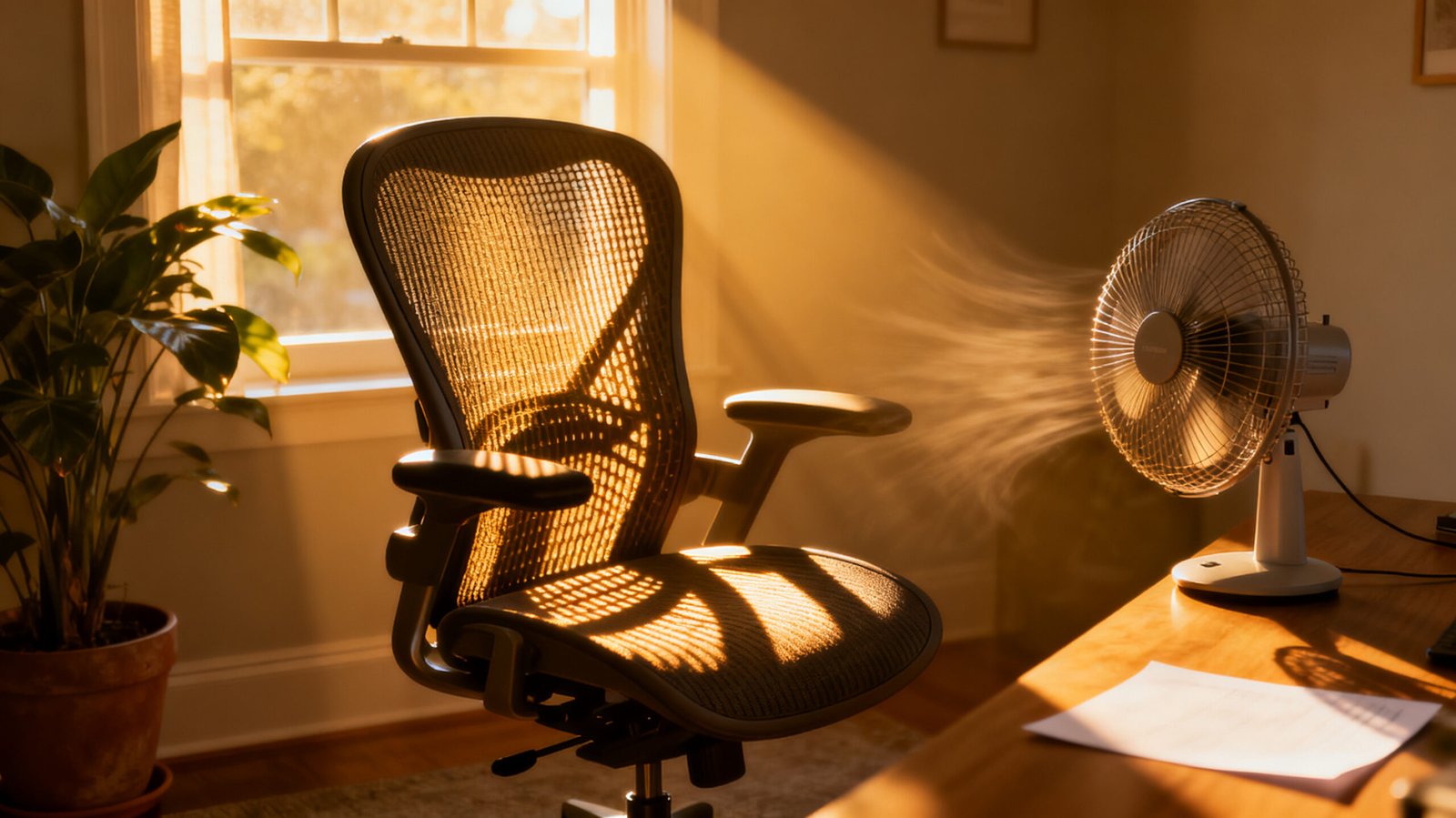
Market snapshot: why breathable chairs exploded and what marketers aren’t telling you
The global mesh office chair market was valued at about $4.1 billion in 2024, with the broader home office furniture market reaching $15.5 billion in the same year, according to industry reports. Remote and hybrid work drove massive demand for ergonomic seating. Mesh chairs specifically benefited because they promised something foam and leather could not: staying cool during long summer workdays.
But here is the core problem. No standard cooling rating scale exists across office chairs. There is no equivalent to a TOG rating for bedding, no universal CFM benchmark printed on the spec sheet. Brands use phrases like “breathable office chair” and “ventilated back” as marketing differentiators, not as verified performance claims. Review sites echo these qualitative descriptors without attaching numbers to them. This means the entire category runs on trust and anecdote rather than measurement.
If you are shopping for the best mesh office chair for a genuinely hot room, you need to ignore the word “breathable” on the product page entirely. Look instead at whether the seat is fully perforated mesh or just a mesh back with a foam cushion, whether the lumbar area has solid plastic blocking airflow, and whether the warranty suggests the manufacturer trusts its own tension materials to hold up. Our office chair buying guide covers these structural checks in more detail.
Mesh vs foam for summer: what the evidence actually shows and where it’s missing
The qualitative consensus from user reviews and expert comparisons is clear: mesh tends to feel cooler than foam or leather during extended sitting. But that consensus rarely translates into measured outcomes. Most articles make claims like “mesh is cooler” or “foam traps heat” without including skin temperature changes in degrees Celsius, microclimate humidity readings, or evaporative resistance comparisons.
What would a proper mesh vs foam office chair comparison need to measure? Three things. First, skin temperature rise at the seat and back interface over time. Second, local humidity buildup between the body and chair surface. Third, evaporative resistance, which determines how effectively sweat can turn into vapor and escape. None of these metrics appear in consumer facing chair specs. As noted in our research, direct quantified statistics specifically isolating temperature regulation are not available in current market reports. The industry simply has not adopted thermal comfort standards like ISO 7730 or ISO 14505 for office chair evaluation.
This means choosing the best mesh chair for summer requires you to evaluate indirect signals: full mesh versus partial mesh construction, the presence or absence of solid plastic in the lumbar zone, and whether the seat pan allows air to circulate underneath your thighs. If you are also dealing with back pain from long sitting sessions, our guide on the best office chair for back pain covers the ergonomic side of the equation.
The three overlooked technical issues every buyer in a hot room should know
Most top ranking content on mesh chairs misses three technical realities that change how these chairs perform when the room heats up. These are the gaps that separate a chair that feels cool for 20 minutes from one that stays tolerable across a full workday.
First: quantitative thermal and microclimate measurements are absent. Reviews talk about breathability as if it were binary. But real cooling depends on air permeability rates, contact area between body and chair, and how quickly moisture can evaporate from the skin chair interface. Without CFM numbers or skin temperature data, “cooling” is just a feeling, and feelings vary by person and climate. A chair that feels airy at 72 degrees Fahrenheit may trap heat noticeably at 85 degrees.
Second: body mass and posture interact with airflow in ways marketers ignore. Higher body weight compresses mesh, potentially reducing the air gaps that cooling depends on. A slouched posture presses more of the lower back against the chair, blocking ventilation paths that would otherwise stay open with an upright seated position. Clothing fabric matters too: synthetic athletic wear wicks differently than cotton, changing perceived cooling even on the same chair.
Third: long duration hot room scenarios are almost entirely unstudied. Most comparisons assume air conditioned offices around 72 to 75 degrees Fahrenheit and test durations of 30 to 60 minutes. Real users in warm climates need a mesh back office chair for hot room conditions at 80 to 90 degrees Fahrenheit over 4 to 8 hours. In those conditions, sweat accumulation, skin irritation, and odor retention become critical. Mesh generally dries faster than foam, but the differences in hygiene and comfort over a full day remain anecdotal rather than measured. If you are setting up a complete workspace for warm conditions, our ergonomic workstation setup guide covers positioning and airflow optimization.
What actually fails first in mesh chairs: real user complaint patterns
Negative reviews of mesh chairs reveal consistent failure modes that matter doubly for hot room users. The most common complaint is mesh seat sagging within months to 1 to 2 years. Users describe a “hammock effect” where the seat stretches and loses tension, causing them to sink and feel pressure concentrated under the thighs and sit bones. This sagging increases contact area between body and chair, which reduces airflow precisely when you need it most.
Related to sagging is frame contact. As mesh loosens, users report feeling the hard plastic front edge or a central support bar pressing through. This creates sharp pressure points and further disrupts the already reduced ventilation. Cheaper models also show tearing and fraying around high stress points: the front seat edge, the seam where back meets seat, and anywhere the lumbar support attaches.
Beyond the mesh itself, creaking and structural wobbling increase over time. Gas cylinder failures cause chairs to slowly sink during the day. These mechanical issues do not directly affect cooling but signal overall build quality, which correlates with how well the mesh tension system holds up. For anyone seeking the best mesh office chair that will last, these complaint patterns are a more reliable signal than any marketing copy.
Lumbar support in hot conditions: pressure points that trap heat and which designs fix them
Lumbar support is where ergonomics and thermal performance collide. The most problematic designs for hot room users are fixed central lumbar bulges made of solid plastic. These concentrate pressure on the L3 to L5 vertebrae while simultaneously blocking airflow at the exact spot where sweat tends to accumulate. Users report localized sweating and discomfort where a non perforated plastic pad presses through the mesh.
Solid lumbar pads interrupt the ventilation path that the rest of the mesh back provides, creating a hot spot in the lower back. Even worse are foam padded lumbar sections stitched onto otherwise mesh backs. These trap both heat and moisture right where the spine curves inward. Misaligned lumbar height forces users to either slouch away from the backrest, losing airflow contact entirely, or lean into a poorly positioned support that creates pressure and heat in the wrong spinal zone.
The design patterns that solve these problems are identifiable. Look for continuous tension zoned mesh across the entire lumbar area with minimal solid obstructions. The Herman Miller Aeron’s PostureFit SL uses a dual pad system that supports the sacrum and lumbar while maintaining open mesh airflow between and around the pads. The Aeron’s Pellicle mesh back is divided into zones of varying tension, distributing pressure broadly rather than at a single hard point. Other premium chairs use perforated or slotted plastic lumbar elements or mesh covered lumbar bands that allow air to pass through while still providing support. Height and depth adjustable lumbar systems let you tune support without forcing excessive localized pressure. For a deeper dive into lumbar ergonomics, see our comparison of the Herman Miller Aeron vs Steelcase Leap.
Top 5 cooling mesh chairs: price, weight, and the missing CFM numbers
The five chairs most commonly cited for breathability and cooling span a wide price range. All of them market themselves as breathable or ventilated. None of them publish CFM numbers. Here is what you actually get for your money.
| Chair (2024) | Price Range (USD) | Weight (lb) | Mesh Coverage |
|---|---|---|---|
| Herman Miller Aeron (Size B) | $1,400 to $1,800 | 40 to 41 lb | Full mesh seat and back |
| Herman Miller Sayl | $800 to $1,100 | 37 lb | Mesh back, foam seat |
| Steelcase Series 1 (mesh back) | $500 to $700 | 29 to 30 lb | Mesh back, foam seat |
| Sihoo M57 / M18 | $200 to $300 | 40 to 45 lb | Full mesh seat and back |
| Gabrylly Mesh Office Chair | $230 to $350 | 40 to 45 lb | Full mesh seat, back, headrest |
Why does the absence of CFM numbers matter? Because two chairs can both claim “breathable mesh” while one allows significantly more air to pass through. Without standardized testing, you cannot tell from the product page whether a budget full mesh chair actually ventilates better than a premium partial mesh design. Any precise CFM comparison would require independent lab testing that no consumer publication has yet conducted at scale. For budget conscious alternatives under $300, our roundup of the best ergonomic chair under 300 covers options that balance mesh coverage with cost.
What thermal imaging and IR tests actually show and their limits
Some advanced reviewers post IR camera images comparing surface temperatures after sitting in a chair for 30 to 60 minutes. These demonstrations consistently show mesh seats and backs with less overall temperature increase and more even heat distribution compared to leather or dense foam chairs. Hot spots on mesh chairs appear primarily where the body contacts the frame, not across the entire sitting surface.
But these tests have a significant limitation. They are qualitative, short duration, and almost always conducted in air conditioned rooms. There is no widely cited, standardized 4+ hour IR thermal imaging comparison across multiple mesh and foam office chairs in a non AC room at 80 to 90 degrees Fahrenheit. The evidence supports a directional conclusion that mesh runs cooler, but nobody can tell you precisely how many degrees cooler a specific model stays after a full workday in a hot room. Anecdotal user reports suggest full mesh chairs remain more tolerable than leather or thick foam over long sessions, but some users still report sweat and discomfort at contact points with non mesh components like lumbar pads, headrests, and padded armrests.
DIY tests to evaluate cooling and long term durability before you keep or return a chair
Since no standardized metrics exist for cooling performance, you should run your own objective checks during the return window. These five tests take less than an hour total and give you data rather than impressions.
Test 1: the 30 to 60 minute IR or surface temperature check. Use an infrared thermometer or thermal camera if you have one. Measure the seat and back surface temperature immediately after standing up from a 30 to 60 minute sit session. Compare the temperature increase relative to the room ambient. A smaller rise and fewer hot spots indicate better ventilation. If you see concentrated hot zones over 10 degrees Fahrenheit above room temperature, that chair is trapping heat at those points.
Test 2: humidity microclimate check. Place a cheap humidity sensor or even a plastic strip indicator between your lower back and the chair back. After 30 minutes, check the reading. High humidity buildup means sweat is not evaporating efficiently through the mesh. This is the test that separates genuinely breathable backs from mesh that is mostly cosmetic.
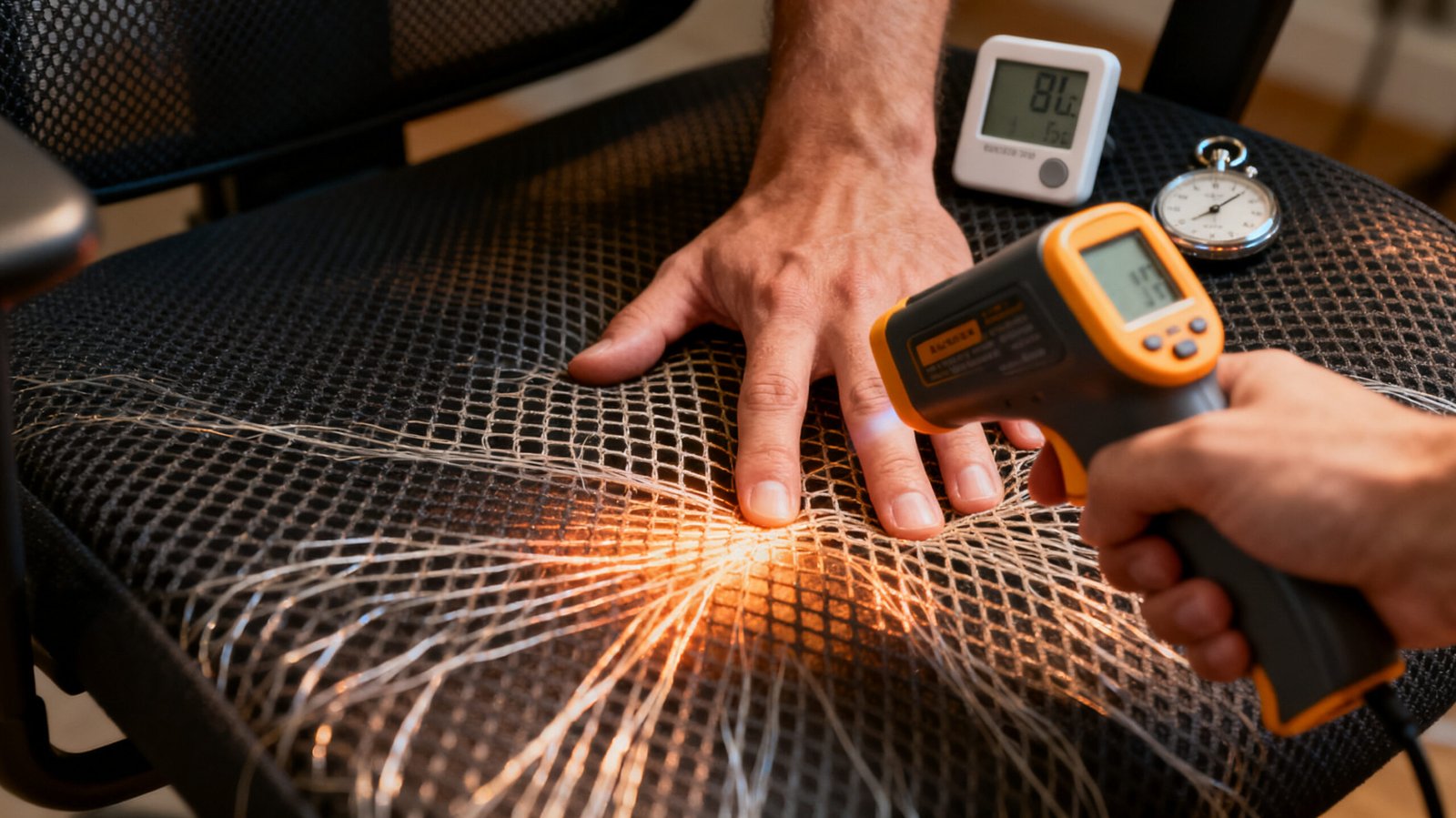
Test 3: sit compression test for mesh tension. Sit in the chair for a continuous 2 hour session. When you stand up, check whether the mesh seat immediately returns to its original flat tension or shows visible sagging. Press your hand into the seat. If it feels noticeably looser than when new, that is an early warning of future hammock effect. Heavier users should be especially attentive to this test.
Test 4: lumbar adjustment range and perforation check. Adjust the lumbar support through its full range. At each position, check whether solid plastic or foam blocks the mesh back. Run your hand behind the lumbar area while seated. You should feel airflow reaching your lower back. If a solid pad presses firmly with no air gap, expect a sweat spot there during summer use.
Test 5: assembly and wobble checklist. After assembly, rock side to side firmly. Any creaking, lateral give in the backrest, or armrest wobble on day one will only get worse. Check the gas cylinder by sitting and verifying the chair holds height without slowly sinking over 30 minutes. Return the chair immediately if it fails any of these structural checks.
Warranty and returns: what brands actually offer and what data you can’t get
Warranty length is one of the strongest signals of how long a manufacturer expects its mesh to hold tension. Herman Miller offers up to 12 years on the Aeron and Sayl, covering mesh and mechanisms. Steelcase chairs commonly carry 12 year warranties for structural and mechanical components. Sihoo typically offers 3 years on the M57 and M18 models. Gabrylly lists 1 to 2 years for parts. The pattern is straightforward: longer warranties correlate with higher build quality and better mesh tension retention.
Return policies depend on the retailer. Amazon’s standard window is 30 days, though third party sellers may charge return shipping or require original packaging. Herman Miller and Steelcase authorized retailers often offer 30 to 45 day trial periods with free return shipping and limited or waived restocking fees. DTC ergonomic brands frequently advertise 30 to 100 day trials on direct sales.
What you cannot get is return policy failure rates. There are no public quantitative statistics on what percentage of mesh chairs get returned, how many warranty claims are denied, or which failure modes drive the most returns. Any numeric estimate would be speculative. This lack of transparency makes the DIY tests during the return window even more essential. If you are also shopping for a lightweight mesh desk chair that is easy to move, the Steelcase Series 1 at roughly 29 to 30 pounds stands out in the comparison table above.
Buying checklist for hot rooms: the 8 must have features
Use this quick scan checklist when evaluating any mesh back office chair for hot room use. Every item addresses a real failure pattern identified in user complaints and ergonomic research.
1. Full or fully perforated mesh back with no solid upholstered panels blocking airflow.
2. Continuous tension zones rather than a single uniform stretch, which distributes pressure and maintains airflow gaps.
3. Perforated or mesh covered lumbar support with no solid plastic plates pressing through the back mesh.
4. Adjustable lumbar height and depth so you can position support without forcing your spine into a hot spot.
5. Minimal solid lumbar plates or pads. If the chair has a lumbar pad, confirm it is ventilated or at least narrow enough to leave surrounding mesh open.
6. Ventilated or mesh seat or a waterfall edge foam seat. Beware of fully mesh seats without padded front edges, which can cut into thighs after several hours.
7. Breathable armrest and headrest materials. Padded and upholstered armrests absorb sweat and degrade faster in hot conditions.
8. Reputable long warranty. Research shows mesh sagging often occurs within months to 1 to 2 years. Choose designs with distributed tension and warranties of 5 years or more. The 12 year coverage on Herman Miller and Steelcase products is not just marketing; it reflects engineering confidence.
For heavier users: prioritize chairs with reinforced frame edges, higher weight capacities, and documented tension retention. The Aeron’s Pellicle mesh has a long track record of holding tension under heavier loads. Budget note: if you must stay under $300, the Sihoo M57 offers full mesh at that price but expect to replace it within 2 to 3 years of heavy daily use.
Final recommendations and next steps for the buyer

You have three pragmatic buying paths depending on your budget and expectations. The premium path is the Herman Miller Aeron: full mesh, 12 year warranty, and the strongest body of evidence for long term cooling and tension retention. It is the closest thing to a safe bet in a market with no standardized cooling metrics. The midrange path is the Steelcase Series 1 mesh back at roughly $500 to $700. Run the DIY thermal and durability tests during the return window to confirm it meets your needs. The budget path is the Sihoo M57 or Gabrylly full mesh chair at $200 to $350. Accept that these are shorter term solutions and plan to replace them within a few years of heavy use.
The global mesh office chair market sits at roughly $4.1 billion in 2024 with strong product variety but few standardized cooling specs. That means your best strategy is to prioritize measurable testing and warranty coverage over marketing claims. Order your chosen chair from a retailer with a generous return window, run the five DIY tests during the trial period, and do not hesitate to return it if it fails the temperature, humidity, or tension checks. The best mesh office chair for your hot room is the one that passes your own objective tests, not the one with the most convincing Amazon listing. For a complete workspace that complements your cooling chair, check out our clutter free desk setup guide to optimize airflow around your entire workstation.
Frequently Asked Questions
Do mesh office chairs actually keep you cooler than foam chairs?
Directionally yes. Mesh allows more air to circulate and sweat to evaporate compared to dense foam or leather. However, no standardized cooling metrics exist, so the degree of difference varies by chair design. Full mesh seats and backs with perforated lumbar elements perform better than partial mesh designs. Run the DIY temperature and humidity tests in this guide to verify performance for your specific chair and room conditions.
How long does a mesh office chair last before sagging?
User complaints indicate budget mesh chairs often show seat sagging within months to 1 to 2 years of daily use. Premium chairs with tension zoned mesh and longer warranties, like the Herman Miller Aeron with Pellicle mesh, have documented track records of holding tension for a decade or more. The key variables are build quality, user weight, and daily sitting hours.
What should I look for in lumbar support for a hot room?
Avoid solid plastic lumbar pads that block airflow at the lower back. Look for perforated or slotted lumbar elements, mesh covered lumbar bands, or dual pad systems like the Aeron’s PostureFit SL that support the spine while maintaining open airflow paths. Height and depth adjustability also matters so you can position support without creating a hot spot.
Is a full mesh seat better than a foam seat with a mesh back?
For cooling specifically, a full mesh seat ventilates better than foam because it allows air to circulate under the thighs. However, full mesh seats without padded waterfall edges can create pressure points on the thighs after extended sitting. Test both configurations during your return window. Some users prefer a ventilated mesh back paired with a contoured foam seat for a balance of cooling and comfort.
Can I test a mesh chair’s cooling performance at home?
Yes. Use an infrared thermometer to measure seat and back surface temperature after 30 to 60 minutes of sitting. Place a humidity sensor between your lower back and the chair back to check moisture buildup. These simple tests give you repeatable numbers to compare chairs objectively during the return window. A meat thermometer probe works surprisingly well for surface temperature checks.