

A clutter free desk setup is no longer just about aesthetics—it’s a proven productivity system that remote workers, designers, and developers rely on to maintain focus in small home offices. If you’ve ever lost 10 minutes hunting for a cable or felt your stress rise at the sight of desk chaos, this guide will show you exactly how to build and sustain a clean workspace using market-backed tools, technical compatibility checklists, and anti-relapse maintenance systems that actually work.
Key Takeaways
- The desk organizer market hit $3.8 billion in 2025, driven by remote work demand for functional minimalism
- Most clutter-free setups fail within 3–6 months due to inadequate storage capacity and missing habit triggers, not willpower
- A cable-free dual-monitor setup requires specific USB-C PD wattage, VESA compatibility, and staged investment—not one-size-fits-all solutions
- Why a clutter free desk setup matters (quick science + practical payoff)
- Market trends — why now: growth in desk organizers and cable management
- A fast 6-step declutter routine (first 30–90 minutes)
- The cable-free desk blueprint (dual monitors + laptop + peripherals)
- Shopping checklist: what to buy at low / mid / high budgets (items + why)
- Compatibility & technical checklist beginners miss (must-check specs)
- Top real-world complaints to watch for (what marketing glosses over)
- Why clutter setups relapse within 3–6 months — the behavioral causes and fixes
- Small-room, space-optimized ideas (vertical, wall, and multi-use furniture)
- Digital declutter and “desk” beyond the physical (desktop files, browser, notifications)
- Minimalist setups by profession (remote workers, designers, coders, video editors)
- Maintenance system: daily/weekly/monthly checklist + habit cues
- Quick troubleshooting guide & when to upgrade hardware
- Actionable one-page checklist + shopping cart (printable)
- Sources, datasets and gaps we couldn’t fill (instructions for backfilling)
Why a Clutter Free Desk Setup Matters (Quick Science + Practical Payoff)
Visual clutter competes for your brain’s attention bandwidth. Every cable loop, stray Post-it, and orphaned charging brick forces your prefrontal cortex to filter out irrelevant stimuli, draining cognitive resources you need for actual work. The practical payoff of how to make desk look clean and organized goes beyond the Instagram-worthy photo: you’ll spend less time hunting for items, experience fewer mid-task interruptions, and finish your workday with lower mental fatigue.

The desk organizer market’s growth reflects more than consumer trend—it signals that professionals are recognizing workspace design as a productivity lever, not a luxury. However, most published claims about measurable cortisol reduction or quantified time savings lack peer-reviewed backing. You’ll feel clearer focus and faster visual search in daily use, but expect subjective improvements rather than hard performance metrics until more rigorous ergonomic studies emerge.
Market Trends — Why Now: Growth in Desk Organizers and Cable Management
Remote and hybrid work shifted desk organization from nice-to-have to business-critical. The desk organizer market was valued at $3.8 billion in 2025, projected to reach $6.1 billion by 2034 (CAGR 5.4%). The tech organizer market hit $4.2 billion in 2024 and is forecast to reach $8.1 billion by 2033 (CAGR 7.5%), with cable organizers alone accounting for 28% of 2024 revenue.
North America led the broader desk accessories market at $3.4 billion in 2024, expected to hit $6.5 billion by 2033. This isn’t a fad—it’s a structural shift as knowledge workers treat home offices like permanent infrastructure. Investment in a minimal desk setup 2026 configuration is justified when you consider the lifespan of quality monitor arms, docking stations, and modular cable trays. The cable free desk setup guide approach is now mainstream, not just for tech enthusiasts but for anyone tired of tangled power bricks under their IKEA desk.
A Fast 6-Step Declutter Routine (First 30–90 Minutes)
Allocate 90 minutes on a weekend morning. This time-boxed approach prevents perfectionism paralysis and delivers a functional workspace fast.
Step 1: Clear the entire surface (10 minutes)
Move everything—laptop, monitors, pens, coffee mugs, paper stacks—onto the floor or a nearby table. Wipe the desk surface. Seeing a blank slate resets your mental model of what belongs.
Step 2: Triage every item into four bins (20 minutes)
- Essential daily: laptop, primary monitor, keyboard, mouse, notebook
- Weekly use: USB hub, external drive, charging cables for secondary devices
- Rarely used: old adapters, reference books, backup peripherals
- Trash/donate: expired pens, redundant cables, broken dongles
Step 3: Return only essential-daily items to the desk (15 minutes)
Position monitors, laptop, and peripherals in your preferred ergonomic layout. Leave at least 30% of the surface empty for active work zone (notebook, tablet, or temporarily placed items).
Step 4: Cord triage and temporary bundling (20 minutes)
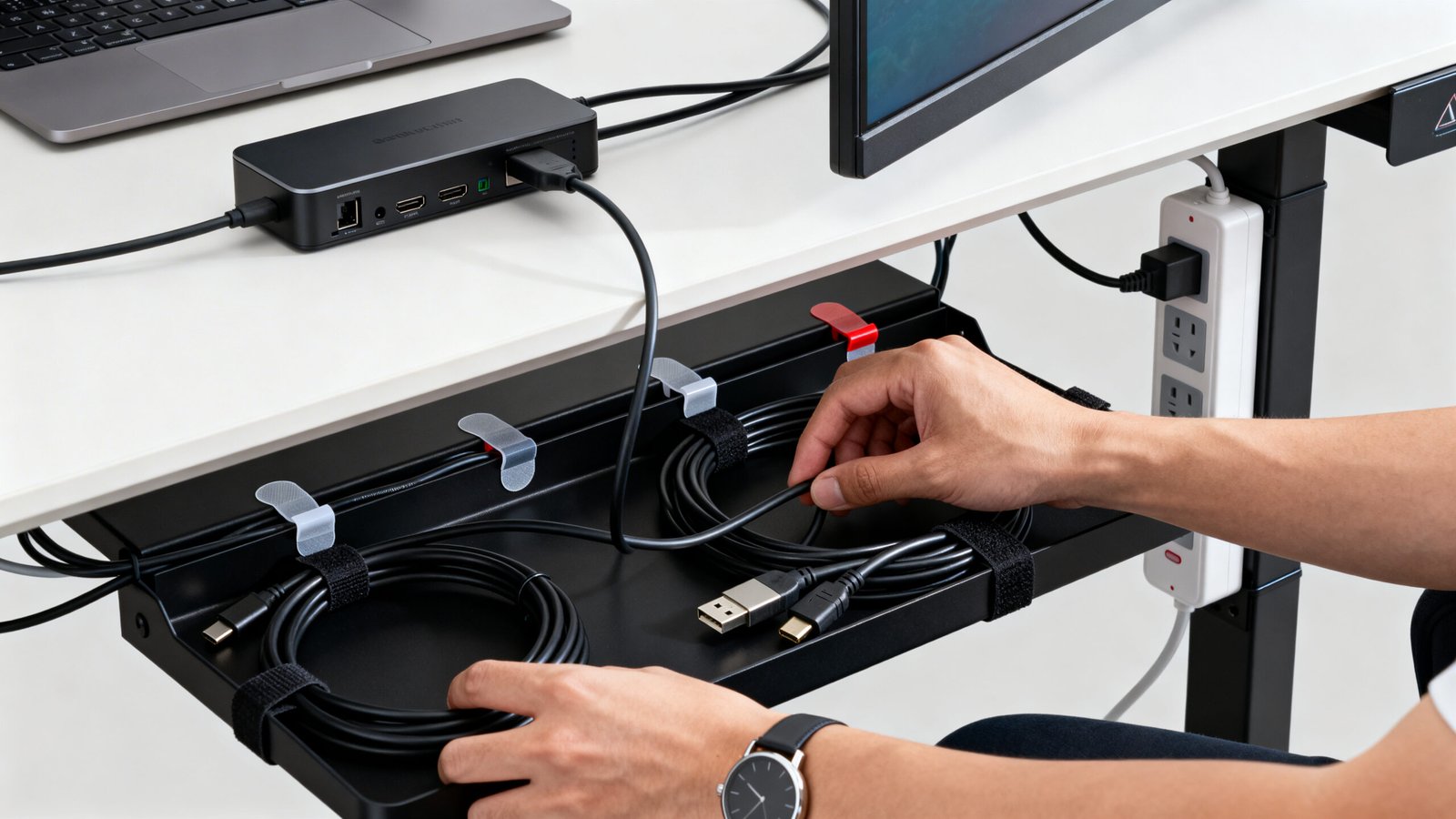
Unplug all cables. Identify which are active vs. legacy (old phone chargers, unused HDMI). Bundle active cables with reusable Velcro straps—avoid zip ties that make future changes painful. Route bundles along desk legs or edges, not across the work surface.
Step 5: Deploy quick storage solutions (15 minutes)
For weekly-use items, grab a small drawer organizer or desktop caddy. For rarely-used gear, use a labeled shoebox or under-desk shelf. The goal is immediate access without surface presence.
Step 6: Take a catalog photo of rarely-used items (10 minutes)
Snap a photo of the contents of your “rarely used” bin and store it in a “Desk Inventory” folder. When you need that Mini DisplayPort adapter in six months, you’ll know exactly where to look without digging.
The Cable-Free Desk Blueprint (Dual Monitors + Laptop + Peripherals)
A true cable free desk setup guide for dual monitors, laptop, and peripherals requires strategic investment and staged rollout. Here’s the exact wiring plan that minimizes visible cables.
Core equipment
- Docking station with 85W+ USB-C PD: Single-cable connection to your laptop for power, video, and peripherals
- USB-C monitors (or DisplayPort + USB hub): Daisy-chain or direct connection to dock
- Under-desk power strip with surge protection: Mount vertically on desk leg or underside
- Cable management tray or J-channel: Adhesive or clamp-mount under desk edge
- Velcro cable ties and adhesive cable clips: Route cables along desk frame
Staged approach
Phase 1 (Partial cable reduction, ~$150–$250): Buy a quality USB-C hub with PD passthrough and mount your power strip under the desk. Bundle and route existing cables along desk legs. Visible cables drop from 8–10 to 3–4.
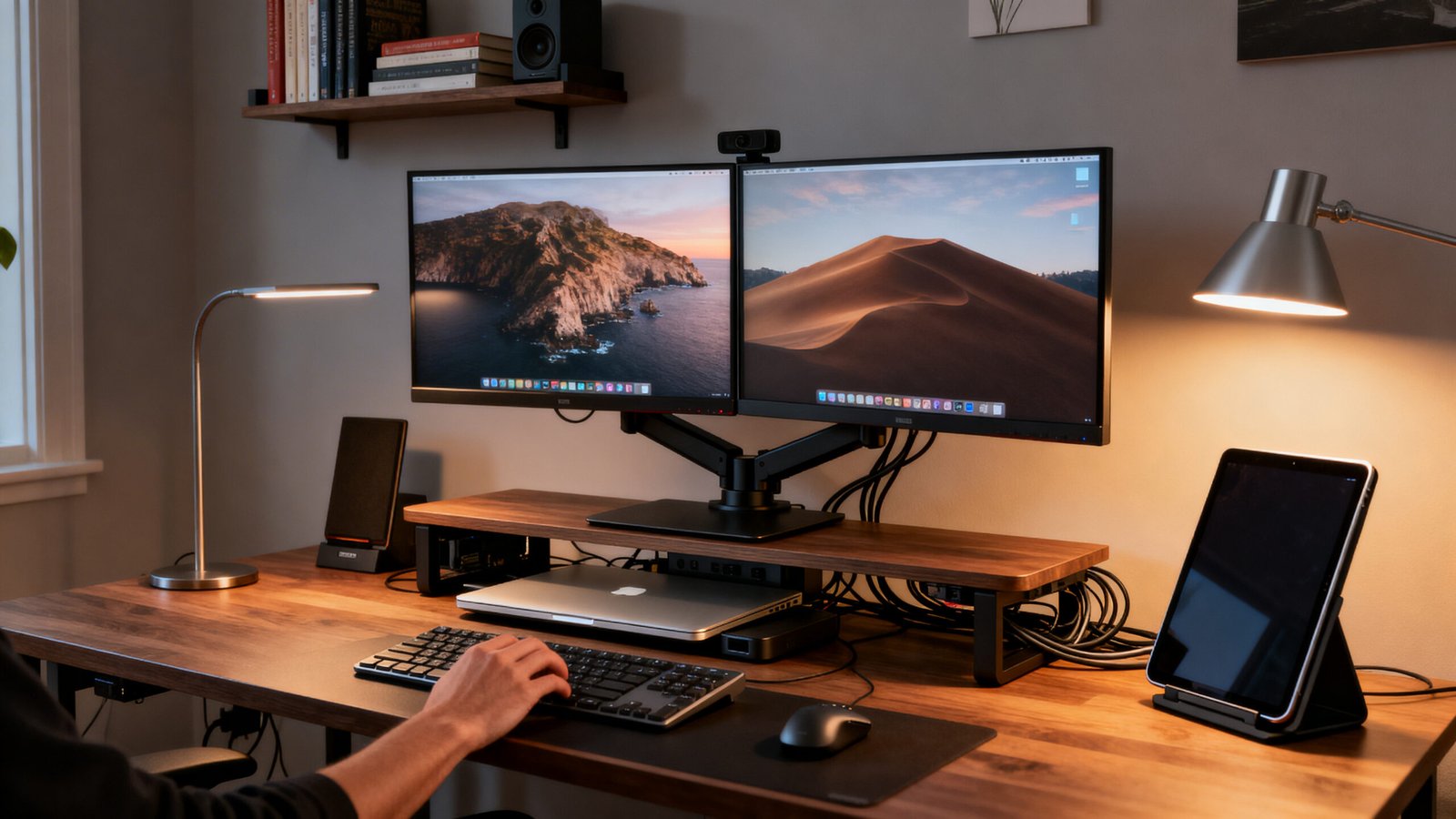
Phase 2 (Near cable-free, ~$400–$700): Upgrade to a Thunderbolt dock and USB-C monitors. Add monitor arms to hide video cables behind the pole. Only the single USB-C cable to your laptop and the dock’s power cable remain visible.
Phase 3 (Wireless peripherals, +$100–$200): Switch to Bluetooth keyboard and mouse. Use wireless charging pads for phone/earbuds. Final cable count: one USB-C to laptop, one dock power cord.
Shopping Checklist: What to Buy at Low / Mid / High Budgets (Items + Why)
Prioritize by impact. A monitor arm delivers more visible improvement than a $60 desk organizer tray.
Low budget (~$100–$200)
- Single monitor arm ($80–$120): VESA-compatible, 17–32 lbs capacity
- Under-desk cable tray ($15–$25): 17-inch steel mesh or plastic J-channel
- Velcro cable ties (50-pack, $10): Reusable, adjustable
- Desktop drawer organizer ($20–$30): Bamboo or plastic, 3–4 compartments
- Adhesive cable clips (20-pack, $8): 3M backing, rated for painted/wood surfaces
Mid budget (~$400–$600)
- Dual monitor arm ($150–$250): Independent height/tilt, 20 lbs per arm
- USB-C hub with 85W PD ($80–$120): 3× USB-A, 1× HDMI, 1× SD card, host charging
- Under-desk power strip ($40–$60): Surge-protected, vertical mount, 6+ outlets
- Cable management sleeve kit ($25–$40): Neoprene zip sleeve + adhesive mounts
- Floating shelf or drawer unit ($60–$100): Wall-mount for rarely-used items
High budget (~$900–$1,400)
- Thunderbolt 4 dock with 96W PD ($250–$350): Dual 4K support, 4× Thunderbolt downstream
- Two USB-C monitors with daisy-chain ($500–$700): 27-inch, 2K or 4K, integrated USB hub
- Premium dual monitor arm ($200–$300): Gas-spring, cable management channels, 25 lbs per arm
- Motorized sit-stand desk frame ($400–$600): Integrated cable tray, memory presets
- Wireless charging station ($50–$80): 3-in-1 for phone, watch, earbuds
Compatibility & Technical Checklist Beginners Miss (Must-Check Specs)
These overlooked specs cause 80% of setup failures and returns.
Monitor arms
- VESA pattern: Check your monitor’s back—75×75mm or 100×100mm. Non-VESA monitors need adapter plates.
- Weight capacity: Ultrawide monitors often exceed 20 lbs. Verify per-arm limit.
- Desk thickness: Most clamp mounts fit 0.4–2.75 inches. Glass or floating desks need grommet-mount arms.
USB-C hubs and docks
- Power Delivery wattage: MacBook Pro 16-inch needs 96W; Dell XPS 15 needs 130W. Hub specs often list “up to 100W,” but subtract 15W for hub operation—real host charging may be 85W.
- Video output: Single HDMI = one external display. Dual 4K requires Thunderbolt 3/4 or DisplayPort MST.
- Cable rating: USB-C cables must be PD-rated for power. A data-only cable won’t charge your laptop.
Cable management
- Adhesive vs. clamp: 3M VHB tape holds on painted wood/metal. Fails on textured or porous surfaces. Clamps need desk edge access.
- Cable strain points: Sharp 90° bends at USB-C ports damage cables. Use right-angle adapters or service loops.
Top Real-World Complaints to Watch For (What Marketing Glosses Over)
Marketing photos show pristine setups. Real users report these recurring failures:
1. Monitor arm sag and drift
Complaint: Arms designed for 15 lbs sag when loaded with 22 lb ultrawides. Tightening screws strips threads.
Mitigation: Buy arms rated 25–30% above your monitor weight. Gas-spring mechanisms hold position better than friction joints. Check Amazon reviews for “sag” mentions before purchase.
2. Adhesive mount failure
Complaint: Cable trays and clips fall off within 2–4 weeks, especially in humid climates or on laminate desks.
Mitigation: Clean surface with isopropyl alcohol before applying 3M VHB tape. Let cure 24 hours before loading. For laminate or particle board, use clamp mounts or screw-in options.
3. Insufficient dock power delivery
Complaint: Laptop battery drains during heavy workloads despite being “connected to power.”
Mitigation: Verify dock PD output matches or exceeds laptop’s OEM charger wattage. Use the included USB-C cable—third-party cables may not support full PD spec.
Why Clutter Setups Relapse Within 3–6 Months — The Behavioral Causes and Fixes
Most clutter free workspace ideas for small rooms fail not from bad intent but from predictable behavioral traps.
Root cause 1: Inadequate storage capacity
You clear the desk, but two weeks later a new USB drive, notebook, and coffee tumbler have nowhere to go. They sit on the surface “temporarily.”
Fix: Build 30% excess storage capacity into your system. If you typically have 10 items to store, design for 15. Use modular drawer inserts that expand as needs change.
Root cause 2: No habit trigger or reinforcement
Without a cue, the “5-minute evening tidy” never happens.
Fix: Anchor tidying to an existing habit. When you close your laptop lid at end of day, spend 2 minutes returning items to their homes. Use a phone reminder at 5:45 PM for the first 30 days until the routine sticks.
Root cause 3: High friction in put-away process
If you need to open three drawers and unwrap cable ties to store a charger, you’ll leave it on the desk.
Fix: Design for lazy compliance. Use open trays or magnetic strips for frequently moved items. Reserve drawers only for true long-term storage.
Root cause 4: No inbox for ephemeral paper
Receipts, sticky notes, and printouts pile up because there’s no designated landing zone.
Fix: Place a single vertical file sorter or small tray labeled “Inbox” on your desk. Process it weekly: scan/photograph, file, or trash. Never let it overflow.
Root cause 5: Cable re-introduction without audit
You buy a new phone, add a second charger, connect an external SSD—suddenly five new cables live on your desk.
Fix: Monthly cable audit. Every new device triggers a question: “Can I charge this wirelessly or at a non-desk location?” Route new cables immediately using your existing management system.
Small-Room, Space-Optimized Ideas (Vertical, Wall, and Multi-Use Furniture)
In apartments and shared offices under 120 sq ft, horizontal space is premium. Go vertical and multi-use.
Wall-mounted monitor arms
Standard desk-clamp arms consume 6–8 inches of depth. Wall-mounted VESA arms free the entire desk surface. Ideal for floating desks or glass tops. Requires studs or heavy-duty drywall anchors rated 50+ lbs.
Floating shelves above the desk
Install two 24-inch shelves 18 inches apart, 12 inches above your monitor line. Store books, small plants, and rarely-used gear. Keeps items visible but off the work surface.
Under-desk CPU/tower mount
Lifting a desktop tower off the floor improves airflow and frees 1.5 sq ft. Use adjustable-width mounts (fits ATX to Micro-ATX cases) with slide-out trays for easy access.
Fold-away desks and murphy workstations
Wall-mounted fold-down desks (16–20 inches deep) work for laptop-only setups. Not suitable for dual monitors unless using portable displays.
Multi-use furniture
Desks with integrated file drawers, pegboards, or pull-out keyboard trays consolidate functions. Avoid over-complicating; each feature adds cleaning and maintenance burden.
Digital Declutter and “Desk” Beyond the Physical (Desktop Files, Browser, Notifications)
Physical minimalism loses impact if your screen is chaos. Treat your OS desktop and browser as extensions of your workspace.
Desktop icon purge
Limit desktop icons to 5 or fewer. Use Stacks (macOS) or Fences (Windows) to auto-organize. Move documents to dedicated folders with clear naming conventions: YYYY-MM-DD_Project_Version.
Downloads folder automation
Set a weekly calendar reminder to purge your Downloads folder. Use tools like Hazel (macOS) or File Juggler (Windows) to auto-sort by file type or date.
Email triage system
Apply Inbox Zero principles. Use filters to auto-label newsletters, receipts, and notifications. Archive or delete—don’t leave read mail in the inbox.
Notification hygiene
Disable all non-critical notifications. Keep only messages, calendar alerts, and mission-critical apps. Schedule “check-in” times rather than allowing constant interruption.
Tool recommendations
- macOS: Hazel (file automation), Alfred (launcher), BetterTouchTool (window snapping)
- Windows: Everything (instant file search), PowerToys (window manager), File Juggler (auto-sort)
- Cross-platform: Notion or Obsidian for note consolidation, Rescue Time for focus tracking
Minimalist Setups by Profession (Remote Workers, Designers, Coders, Video Editors)
Each role has unique equipment and layout tradeoffs. Here are reference 10–12 item lists tailored by profession for a minimalist desk setup for remote workers.
Product designer / UX researcher
- Mechanical keyboard (compact 75% layout)
- 27-inch color-accurate monitor (99% sRGB, factory calibrated)
- Drawing tablet (Wacom, XP-Pen) with pen storage
- Laptop on stand or vertical dock
- Wireless mouse + trackpad
- Monitor arm
- Under-desk cable tray
- Desktop lamp with adjustable color temp
- Small notebook for sketching
- USB-C hub with SD card reader
- Wireless charging pad
Rationale: Designers need color accuracy and space for tablet/sketching. Tablet stored vertically when not in use. Dual peripherals (mouse + trackpad) support varied workflows.
Software developer / DevOps engineer
- Two 24–27-inch monitors (landscape or portrait)
- Laptop closed in vertical dock or clamshell mode
- Mechanical keyboard (full-size or TKL)
- Ergonomic mouse
- Thunderbolt dock with multiple USB-A ports
- Dual monitor arm
- Notebook for architecture diagrams
- USB-C to Ethernet adapter (wired reliability)
- Headphone stand with USB DAC
- Under-desk cable management
Rationale: Coders prioritize screen real estate and stable connectivity (Ethernet over Wi-Fi for SSH/VPN). Closed clamshell mode maximizes desk space.
Video editor / motion graphics artist
- 32-inch 4K monitor (HDR, wide color gamut)
- High-performance laptop with external GPU enclosure (optional)
- Editing keyboard (Loupedeck, TourBox)
- High-precision mouse or trackball
- External SSD (2TB+, Thunderbolt 3 for fast proxy workflows)
- Monitor arm (heavy-duty, 30 lb capacity)
- USB-C dock with multiple Thunderbolt downstream ports
- Headphones + audio interface
- Under-desk cable sleeve (thicker gauge for video cables)
Rationale: Large screen for timeline scrubbing. External SSD essential for 4K footage. Fewer peripherals because editing keyboards consolidate functions.
Copywriter / content strategist
- Single 24–27-inch monitor (or laptop + portable monitor)
- Laptop on stand
- Mechanical or quiet membrane keyboard
- Simple wireless mouse
- USB-C hub (basic: 1 HDMI, 2 USB-A)
- Monitor arm (optional, for adjustable height)
- Analog notebook and pen cup
- Small desk lamp
- Wireless charging pad
Rationale: Writers need minimal tech but benefit from ergonomic height adjustment and distraction-free layout. Analog tools remain central for ideation.
Maintenance System: Daily/Weekly/Monthly Checklist + Habit Cues
Sustaining a clutter free desk setup requires scheduled rituals, not willpower.
Daily (5 minutes, end of workday)
- Return all items to designated homes (pens, notebooks, USB drives)
- Wipe desk surface with microfiber cloth
- Coil and secure loose cables with Velcro ties
- Empty coffee mugs and water bottles
Habit cue: When you close your laptop lid, immediately start the 5-minute reset. Link it to your shutdown routine.
Weekly (15 minutes, Friday afternoon or Sunday evening)
- Process desk inbox: scan receipts, file papers, discard junk mail
- Check cable management: any new devices that need routing?
- Vacuum or dust under desk and around cable trays
- Review digital desktop and Downloads folder